Wednesday, 31 May 2023

My Poetry: You


You rushed early into this world
eager to see what it was all about
locked your eyes on mine
and didn’t look away.
Then I knew. Knew
that it is possible for a heart to grow,
like cells building new life.

You take your time, assessing,
finding your place. Charming strangers
with your smile. Absorb the world
from my shoulder. Thank me
when I chase away the night-time
monsters. Take little imp as a compliment!

You share, without hesitation,
your treasures  -  your opinion,
and the mysteriously melted chocolate-buttons
smeared across your hands. 
If only time didn’t rush
if only it would be more sharing         
if it would
     trickle
just a little. Not a lot to ask.


(Written in the early 80's)


My Poetry: This Boy


This Boy 

This boy trains worms;
Chases geese, not seeing the danger;
Shakes his head that we don’t know they are only laughing.
Strides the mountain path, self-peeled stick in hand.

This boy wanders;
Digs in the rocks by the loch  
on his own and wonders what the fuss is about.
Makes dandelion-chains because no one else does.

This boy. This boy;
before he could talk, grasped my hands
and we laughed and couldn’t stop, at something
or nothing.  How can it be that someday this boy…
This boy will be a man?


(Written in the early 80's)


Prince Dhruva, Aged Five, Sees Eye To Eye with God


He stood in that one place
in the forest, on one leg.
Wild pigs foraged his shadow.
He stood, gown as white
as the chunam of palace walls,
like a painting of the women
who danced for the courtiers,
struck in a pose of the nautch.

As he stood in that place
in a clearing by a brook
and saw slender branches
bend beneath the kingfisher,
the child stilled his chest
until a breath spanned a day.

Through the cramp,
he saw the feeding doe start
as hoopoe dipped curved beaks.

As infant bones set,
he saw the giant Chinar tree
trap snow in outstretched arms.

Through splayed toes green shoots
spread, embracing, winding
tethering - he soared in the wake
of the crows who followed
bears for pickings, saw a beetle grasp its prey,
a tiger groom her young, finite forest on finite land.
Saw the world cupped in the palm of Krsna,
saw his own heart, and looked eye to eye with God.

And the child knew that he was blessed,
for if he followed this austerity
with celibacy, piety,
equanimity and charity, he might
perhaps, atone past-life sin.

And as the child was carried from the forest
he tried not to remember the despair
he had witnessed when he looked
into the eyes of God.


Nature's reading room


As a child, I gravitated toward reading outside. I like to think it was because I was imaginative and adventurous, but I suspect it had more to do with the fact that I had four younger siblings.

If you’ve never sat under a weeping willow with your favourite author, go - go do it now. (Take a flashlight if the sun has already clocked off for the day.) Not just any weeping willow, though; the tips of the branches must sweep all the way to the ground like a Victorian skirt, creating a private green room where little beggars - be they siblings, children, or even colleagues - can’t find you.

As a young teen, I graduated to the sturdier upper limbs of elm and oak trees. Fields of wildflowers worked too, provided there was a rock or a tree trunk to lean against. My friends and I even had a library in a forest. We wrapped our books in waterproof, waxed bread wrappers and tucked them into cubbies formed by tree roots, meeting daily to read, using mossy rocks as seats and tables. I suspect more than a few of those books are still hidden on the forest floor, all these years later.

Have you noticed - people tend to experience the world differently depending on their interests or professions. On a drive through Saskatchewan, for example, an Australian rancher friend pointed out coyotes lurking in ditches, a camouflaged deer in a field, and bear cubs clambering up a tree trunk. What had been a pleasant enough drive suddenly felt like a National Geographic special, simply because my companion was tuned in to what caught his eye. Another friend worked with power lines - not just poles and wires, as it turns out, but miles and miles of much more than that.

It’s the same for me. Even now, the landscape around me is mentally mapped into reading nooks: a cosy patch of grass by the riverbank, the inviting crook of a tree branch, a wooden pier dappled with sunlight.

The weeping willow remains my all-time favourite, but the nearest one is three streets away - and apparently they “ find it a bit strange for a grown woman to camp out on our lawn.” So I make do with my comfortable bed. The lamp casts a gentle circle of light, and except for the cat on my shoulder and the dog draped across my feet, it’s almost the real thing.

Almost.

Without the ants.

Amazon Creative Writing Guides

Denise Howie World Famous in B.C.

A Gem of a Writing Job

(Originally published in 2014. )
Photo by Mary Whittaker 
Back in the 80’s with a handful of magazine stories to my pen-name I dreamed of being a newspaper journalist; not so much a reporter who is generally limited to facts, but a journalist who would cast a light on the lives of local artists and characters who were lost in the shadows of Thatcherism and MTV.
 Looking back, I have realised that dream…minus the British Press Awards… 
 Much of my current writing life is devoted to a local ‘Little Engine that Could’ The One Person Project: A small group in my hometown who harness the goodwill and skills of communities in the region to take realistic steps towards helping a community in Tanzania to become self-sustaining.  In-line with my goals I have also written articles about Okanagan writers, artists and businesses and was thrilled to be asked to provide the web content for Tourism Summerland earlier this year.
 I also had the good fortune of personally and professionally connecting with artist Karen Griggs who fashioned her passion for jewelry and love of community into an innovative award-winning business. Bead Trails is a marketing success-story that promotes Okanagan businesses and communities by providing a fun scavenger hunt where tourists and locals alike explore the Okanagan Valley in search of elegant and funky beads to create a meaningful memory bracelet.
 I look forward to writing the upcoming Bead Trail newsletters and blogs but to be honest, providing web & brochure copy, press releases and articles for Bead Trails has been a tough gig. Imagine having to spend your days visiting Okanagan wineries, galleries and artists, browsing book shops and boutiques and stopping off for a coffee and cupcake.
 But I guess that’s the price you have to pay if you want to do right by your community!

The creativity (and science) of habit


You’re struggling to finish that novel. You know there’s a box-office hit hiding out in your head. There’s a poem teasing at the edges of your brain - if only you had the time to write.

If we’re honest, though, however busy we are, most of us do have the time. The real problem isn’t time at all. It’s habit.

Habit is one of those buzzwords of success, attached to everything from exercise and diet to career advancement. And for good reason. Habits quite literally rewire the brain. It generally takes around 28 days. So if you want to change something in your life, or add something new, commit to it for a month.

There’s solid science behind this idea, and one of the most striking examples comes from NASA. In the early days of the space program, researchers wanted to understand the physiological and psychological effects of spatial disorientation in a weightless environment. Astronauts were given convex goggles that flipped their vision 180 degrees, forcing them to see everything upside down. They had to wear them 24 hours a day for 30 days.

As you can imagine, this made life extraordinarily difficult.

Then, on day 26, something remarkable happened. One astronaut found that his vision had turned right-side-up again - despite still wearing the goggles. Between days 26 and 30, the same thing happened to the remaining astronauts. Their brains had created entirely new neural pathways.

Just as fascinating was what happened next. It took roughly the same amount of time for their brains to readjust once the goggles were removed. In a later version of the experiment, half the astronauts were allowed to remove the goggles for just 24 hours on day 15. When they put them back on, it still took another 25 to 30 days for their brains to adapt. Breaking the continuity of the new habit - just once - sent them back to square one.

As Aristotle famously said, “We are what we repeatedly do. Excellence, then, is not an act, but a habit.”

In The Artist’s Way, the seminal book on creativity and creative recovery, Julia Cameron introduces Morning Pages - a simple but powerful daily practice. Each morning, you hand-write three pages about anything and everything that comes into your mind. The pages don’t have to make sense. You write first thing, she explains, because “you’re trying to catch yourself before your ego’s defenses are in place.”

This stream-of-consciousness ritual establishes the habit of writing, clears mental clutter, and creates space for ideas to surface.

And then there’s Stephen King. When he’s working on a book - which is most of the time - he writes every day of the year. That includes Christmas, the Fourth of July, and his birthday. King finishes a draft in about three months, but he’s also quick to point out that writing just 300 words a day is enough to complete a novel in a year.

In the end, it really is that simple.

It’s just a matter of getting into the habit.


My Childhood: Fact or Fiction?

Don’t decide to base your first book on your childhood - especially if you lived in six countries and didn’t keep a journal.

I started writing this book thirteen years ago and I’m about three-quarters of the way through. I’m not lazy. I’ve been published many times in the intervening years, but this particular project is forever shunted to the back burner. Take a guess at what I was working on moments before I distracted myself by opening a fresh page on this blog…

I’ve always called it a novel because, although it’s rooted in the facts of a period of my life, I’ve had to invent conversations and events to bridge the inevitable gaps in memory. After all, the main character - me - is only five years old when the story begins. But really, I should learn to call it what it is: a memoir. All memoirs are crafted in the same way. The story tells the truth of the life being described, but by necessity, it cannot all be true.

My father was in the Royal Air Force - a blessing that meant my childhood was designed for adventure. Another blessing is that there are countless online groups and forums devoted to reminiscing about life as a services or military child in the 1960s and 70s. There is, it turns out, an eager readership for memoirs like mine.

And yet, this is also a curse. Those experiences matter deeply to my fellow brats (the Forces acronym for British Regiment Attached Traveller), and that sense of shared history comes with an unspoken expectation: get it right. Be accurate. Don’t muddle the details.

I’m not just describing my life - I’m chronicling a way of life. The peculiar, transient world of a military child in the 1960s. I take comfort in the fact that all any memoirist can do is recount how they experienced, and now reinterpret, the events around them. Even within one family, each person deciphers shared moments differently. Still, there’s a certain pressure in knowing that not only my siblings, but an entire generation of former brats, may quietly question my version of events.

Many of our family photographs have been lost. I’m the eldest child, and my parents both died while still in their fifties, so I have little tangible material to draw from. What slows me down the most is my unreliable memory of geography. Even with the help of the internet, so much time has passed that I’m often researching what feels like an entirely different planet.

Frustratingly, old maps don’t track my footsteps the way the Marauder’s Map does in Harry Potter. I know my peers will be forgiving, but it will undoubtedly jar if I describe turning left to reach the Malay village when, in fact, I could only have turned right. Then again, their retrospective GPS may be just as sketchy as mine. Here’s hoping.

Needless to say, my second book will be a proper novel. It will be set in space. The main character will keep a journal that she starts writing in at the age of five.

Because she is, quite clearly, a much smarter cookie than I ever was.


When someone stole my idea and got rich and famous (or not)


When I was thirteen, it took me three whole years to write a novel.
All right - a novella - called Various Shades of Blue. It was about a society living inside a dome made from carboxygememtellan: carbon, oxygen, and a miraculous, unbreakable, breathable gel.

At the age of thirteen.

Clearly, I was a genius.

The dome was known as the Blue Dome. You could tell a person’s status by the shade of blue they wore, and there were rumours of distant domes - red, green, and yellow.

So you can imagine my shock when Logan’s Run was released in the mid-1970s and I realised it bore an alarming resemblance to my story. An apparently idyllic society. A population convinced that the planet beyond was uninhabitable, destroyed by natural and man-made disasters. Whispered rumours of a Safe City. Strict population control through euthanasia at a fixed age. A group of protagonists who flee the dome, risking everything to discover the truth.

Suspiciously familiar, wouldn’t you say?

My own story concluded with the surviving characters - those I hadn’t killed off (sorry, BFF Shelagh; I know you never fully forgave me for that) - huddled in a cave, drawing up ten new rules, or rather commandments, for future generations to live by, ensuring the planet would never fall into such a sorry state again.

A genius, I tell you.

The final descriptive passage made a subtle reference to gills in the characters’ necks. Make of that what you will.

Naturally, upon discovering my story had been cruelly stolen, I drew up a list of suspects.
My parents? No - they were the ones who alerted me to the film, and Dad was still driving his distinctly unimpressive Cortina. The three teachers who had read, and spell-checked, my masterpiece? Possible.
And then there was the aforementioned Shelagh, who might still have been harbouring a grudge.

Thankfully, before court proceedings were initiated, I discovered that Logan’s Run was based on a book published in 1967 - two years before I came up with the idea. When most of my beta-readers were commenting on my work, I was living in Cyprus, which may explain why none of them had read the book. News travelled slowly there; the more fashionable or noteworthy something was, the longer it took to arrive.

If someone produces an idea eerily similar to yours, people will tell you to console yourself with the phrase “Great minds think alike.”
No? Didn’t help me either.

But history is full of such coincidences. Alexander Graham Bell and Elisha Gray filed patents for the telephone within hours of each other. Isaac Newton and Gottfried Wilhelm Leibniz independently developed calculus at roughly the same time. And in 1992, Susie Blenkinsop turned up at improv night in the upstairs bar of the Dovecot Theatre in Stockton wearing the exact same Laura Ashley midi-skirt and Romanesque sandals as I was.

So believe me when I say - I understand your pain.

I could dwell on those three “wasted” writing years, but I prefer to think of them as earning my writing chops. (Whatever that means.)

Anyway, the novel I’m working on now is about a girl on a train.

I just know it’s a winner.


Tuesday, 30 May 2023

My poetry: 1960's


1960’s

My paper dolls. My fish and chips
My Tiny Tears. My pick-up sticks
My invisible horse. My invisible friend
My den. My castle. Days without end.
Snakes and ladders. Etch-a-sketch
Sindy. Trolls. Dogs playing fetch.
My hula hoop. My magic wand
My tiddley-winks.  A stinky pond.
The Secret Seven. The Famous Five
Swallows and Amazons. The Call of the Wild.
My roller skates. My spinning top
Hopscotch. Elastics. Parachute drop
Pink school milk. Climbing trees
My fishing net. Scabs on knees
Whist. Gin Rummy. Memory games
Rosehips. Brambles. Country lanes.


Read here for my workshop on writing a similar poem.
Amazon Creative Writing Guides

Denise Howie World Famous in B.C. 


Monday, 29 May 2023

My Poetry: The Cull


The Blackfoot brave chose not to take part

in the driving of the buffalo. He was young

and by definition, foolish.


Instead, when his people, the Plains people

drove the buffalo over the sandstone cliff

he chose to stand below the overhang

and watch the bodies fall. Feel the thrill

of a black bellowing waterfall.


When his people came to do the butchering

they cleared the last carcass and found

the brave, with his skull crushed in.


A hell-of-a-way to get a town named after you.


(Head-Smashed-In Buffalo Jump – Alberta, Canada.)


Sunday, 28 May 2023

My Poetry: To an Egyptian Working Man


To An Egyptian Working Man

We met in Toronto.  I’m the woman
who couldn’t keep her eyes off you, stood
stock still as the crowd peeled past.

Embarrassed, I took your photograph.

My husband wandered off, used to my ways.
He’s been really good about it all.
I talk about you often, have your photo
propped on the mantel clock.
He gives me a look now and then, but doesn’t comment.
Probably feels safe, with you being
on another continent.

But something did happen…
You looked so vulnerable, vacant,
slack-mouthed and dreaming.
Dreaming of eyes? Of painted hands, of perfumes that teased
the weaver, in the workshop of the temple of the King?

They’ve placed a square of lint across your groin.

I saw the x ray, fluorescent with hunger, infection.
Learned of parasites that stole your strength.
Were you handsome once?
Did the palace women ever notice the weaver?
Or were you, even then, a guess at a man.
Spent twigs, bound with dirty cracked leather?

One floor up, your starched, ironed shroud
stands outstretched.  A mottle-brown moth.

They’ve placed three saucers by your side:
Heart of Nakht, Liver of Nakht – each a child’s fist of hollow wood –
torn from the tree where you crouched to chew bread.
Brain of Nakht – two dapple black stones – plucked from the beach,
beneath the cliffs that you sucked you dry.

Your dignity label was missing,
The one marked: Private.


Denise Howie World Famous in B.C. 

Saturday, 27 May 2023

My Poetry: Carved by Gravity


Hey Bri,
you know
that fractured piece
of de Chelly sandstone
we saw, the one
that rises
eight hundred
and eight feet
above the surrounding
landscape of
Monument Valley?
Well it's called
The Totem Pole.
Still looks like a willy to me.


Denise Howie World Famous in B.C. 

Friday, 26 May 2023

My Poetry: South Gare


She looked at the man
Summed him up:
On his own,
Sunday afternoon,
Three kids...

He smiled, she smiled
Called her children from the water's edge
So he would know -
From the beginning.

His girls hauled him up.
She studied them,
Younger than her own,
She could grow to love them.

He looked again, smiled again.

They would say she was mad
Taking on his kids -
So soon.

She kept her bare left hand in view.
Could he see the thin white line
That stood between then and now?
She hugged her children,
He smiled,
Gathered-up her future in a blue-cotton
Beach towel. And left.


Thursday, 25 May 2023

Own a piece of Hollywood!


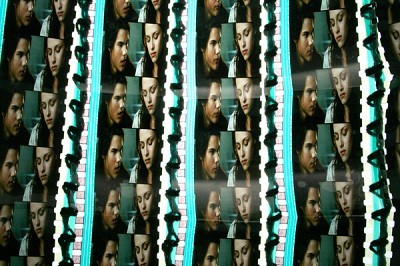
I came across an exciting find while exploring the Portland Saturday Market recently: bags and accessories made from prints of 35mm Hollywood films.

After a movie finishes its theatrical run, distributors are obliged to destroy the physical film. DĂ©jĂ  Bags founder Julie Lewis had the wonderfully simple idea of asking for the reels instead. She cuts the film into strips - thereby complying with copyright laws - and transforms them into unique, practical collector’s items. Lewis uses films made from the late 1980s onward, as they are polyester, which is far more durable than earlier acetate or celluloid stock. The bags and accessories are sewn by a women’s fair-wage cooperative in the Philippines.


deja bag
Each piece is a mix of different Hollywood movies, although some handbags are made entirely from a single popular film, such as Twilight or Slumdog Millionaire. The range includes large tote bags, purses, clutches, belts, ties, and even lampshades.

twilight

Not being much of an accessories person, I chose a lampshade - the perfect way to enjoy film frames every day. A standard feature film runs at 24 frames per second, so not every strip contains a recognisable image. I examined several before settling on one that appears to be made entirely from the Nicolas Cage film Ghost Rider. That said, owning an authentic Hollywood film reel is thrilling in itself, whether you recognise a specific scene or not.

lampshade 1

I don’t actually have a lamp yet - a trip to IKEA is clearly required - but I think you'll get the idea from this picture...

    
lampshade 3

Which brings me neatly to a message for any family or friends reading this: if you ever feel the urge to surprise me, my favourite Hollywood films from the late ’80s onward include Ferris Bueller’s Day Off, Dead Poets Society, Beetlejuice, Steel Magnolias, the Back to the Future trilogy, and Rain Man… though the list could go on.

There is, however, a limited supply. Julie estimates that there are only two or three years’ worth of film left. Before long, movies will exist solely in digital form—and these objects will be rare, tangible relics of the final years of 35mm cinema.


Amazon Creative Writing Guides
Denise Howie World Famous in B.C.

Wednesday, 24 May 2023

My Poetry: New York Directions

Illustration: Victor Kerlow


New York Directions  (1996)


Follow the twin shadow to its extremity. Slap

your feet over the sidewalk - hard. Dodge

yellow cabs, electric people, the tramp brushing the street

with the end of his scarf. Politely, steer through smiling sightseers

and buy a can and a dog - hot, from a stand with the man with an accent

from all the American movies you've ever seen. Make

like a bee for the green line of railing and hedge. Step

through the open gate. Step into the dormant chamber

buried in the chest of this city. Sit on a slatted seat in the shade

of unfamiliar trees, feel the tremble of traffic against your back.

Acknowledge the hum, the drum of the streets, beneath

the cocksure call of a Downtown pigeon.

Smile at: Sitting on the Gravestones is not permitted.

Trace mossed etching with your finger

           
                        Ce Tombeau  

        Qu'a fait eriger Mmm. Catherine Gentil

                         A In Memoire


Toss crumbs for the sparrows building nests

in the cracks of the tombs. Sigh. Step back

through the gate.

                       Then, my friend

it is up to you.


Tuesday, 23 May 2023

The Secret World of Books

Little Eaton, Debyshire, England. 2011
When living in Auckland, New Zealand in the late 90’s I was surprised and delighted to find a copy of The Number 1 Ladies’ Detective Agency on a bench with a note attached telling me to read it and leave it somewhere for the next person to discover. I chose a shaded wall by a beach and left it with a card saying how much I’d enjoyed the book – and to pass it on by leaving it in a public place. I felt as though I was in mystery myself; who might have left the book and what type of person would find it? Would they run with the baton or read it and ditch it?
 Now I was on the look-out, eyes constantly scouring benches, walls and hidden nooks for more literary treasure. And what -do-you-know, there it was, that quintessential kiwi guide – The Edmonds Cookery Book, nestled in the crook of an iconic Pohutukawa tree.  Five-months of searching vindicated!  This time the book had a sticker with the name of a website where I could log my find, leave a comment and follow the book’s journey from beginning to end.
 Now there are a number of similar ventures including  BookCrossing.com which has over two million members who have ‘released’ almost ten million books into the wild in 132 countries.  In 2004 The Concise Oxford Dictionary added the noun ‘bookcrossing.’
 Villages, towns and cities around the world have embraced the idea. In 2009 the UK’s Daily Mail ran an article on a telephone-box book exchange, which was set up by a village in Somerset, England when their mobile library service was closed down. Today around 400 old telephone boxes have been purchased by parish councils, some of which have been converted into book exchanges.
ruilbank-amsterdam-book-clip-designboom-05Amsterdam’s Pivot Creative came up with the idea of turning ten park benches into mini-libraries by creating a red clip to secure books and magazines to them. Pivot co-founders Paula Colchero and Jose Subero hoped that the initiative would “bring people back to the simple pleasure of reading a book, sharing with others, and enjoying common spaces.”  Check it out here.


The idea isn’t new, commuters and travelers have always left newspapers and magazines on a seat or table for the next person rather than pop them in the trash can. But I do like to think of the treasure-trove of books waiting in trees and railway stations, on cafĂ© tables, benches and walls, and the shadowy figures involved in the hidden-in-plain sight dead letter drops.
Let me know your book adventures!


Saturday, 20 May 2023

Never be at a loss for article ideas


ray bradbury
(REPUBLISHED)
Searching for ideas for articles?  Stumped?  
What if I told you that by the end of this 500 word piece you will have the ability to find a hundred or more ideas in less than an hour?


Do it now. Pick up the nearest newspaper or magazine – jot down the first heading or sentence that catches your eye. For example –  from the  front page of The Vancouver Sun (Nov 30th 2013).


“VANCOUVER -- In the first project of its kind in Canada, 12 recycled shipping containers will become social housing for women in the Downtown Eastside by next spring.”
You could write your own article on the same subject. You could also dissect the headline. Brainstorm the first word – “Vancouver” with possible articles in mind. Are there any special dates or anniversaries coming up in this coastal B.C city?  What about “the big one” any information out there regarding Vancouver’s earthquake plan? Did any interesting facts come up in the 2011 census?  Why is Dead Man’s Island so named?  Why is the Vancouver obesity rate almost half that of the rest of Canada? ‘Vancouver’ itself could take up a few pages of ideas but let’s move on.
 “…In the first project of its kind in Canada…”  Does Canada have any other firsts? I took a moment to look this up and discovered that Canada was the first country to be created through legislation. The world's first wireless message was received by G. Marconi in 1910 in St. John's, Newfoundland, and – I love this one - Canada has the world's first fully-simulated Mars base.
 “…Recycled shipping containers…”   Did ancient cultures recycle? What are the oddest things to be recycled?  What else have shipping containers been used for? Well, for starters - the world’s biggest organized market, located in the Ukraine, which is made up of alleys formed by stacked containers, and covers 170 acres. Interesting…  
 “…Social housing for women…” Why target women for social housing? Because statistics show that one in five Canadian Women live in poverty: 21% single mothers, 36% Aboriginal women, 35% visible minority women, 26% women with visible disabilities and 14% single, senior women – according to the Canadian Women’s Foundation.
 “ …Downtown Eastside…” Write about this area being Vancouver’s first settlement, or of the rise and fall of these historic neighbourhoods. What about the success stories and the hopes for the future.
 “…Spring.”  Do I really need to elaborate?  Put a spring in your step with these 5 healthy tips, 10 ways to spruce up your house this spring, spring clean and put cash in your pocket, spring clean your document folders/social media/friends list. How to cope with allergies this spring, where to holiday this spring, home maintenance tips for spring…
 At least 25 off-the-cuff ideas stemming from just one headline on the front page; finish the newspaper and you could have a life-time of diverse article topics!

Monday, 15 May 2023

Widen your Audience: Repurpose to a Different Genre

The Borrowers: Illustrated by Emilia Dziubak
Recycle. Repurpose. Reuse.

We’re finally getting it.

But writers have been doing this all along. As authors, we recycle our own experiences and obsessions. Many popular writers - ancient and modern - return to the same premise again and again, reshaping it into each new bestselling novel. Non-fiction writers, meanwhile, have long mastered the art of repurposing the same information for different audiences.

Today, of course, this practice is more visible than ever. A tweet expands into a blog post, which becomes a YouTube presentation or podcast, which then turns into a magazine article, and eventually emerges as a how-to book - or vice versa.

You know that feeling when you’ve written a piece of fiction and, even after you’ve sent it out into the world or tucked it away in a drawer, it stays with you? Grab that emotion before it’s washed away from the shore and use it to write a creative half-cousin. If a character or storyline has affected you this deeply, it will almost certainly affect others too.

Some years ago, I wrote a 1,000-word short story about a woman named Maggie, who had suffered a devastating loss. It was a dark piece, and at the time I couldn’t find a suitable home for it. Months later, while writing a poem, I realised the voice was familiar. The character in the poem was a version of Maggie - still grieving, still struggling to move on. That poem was published in the Poetry Supplement of the Teesside Evening Gazette in the UK.

Two years later, now living in New Zealand, I decided to enter the Commonwealth Short Story Contest. Maggie still haunted me, so I rewrote the story to meet the 600-word requirement. The tighter version was far more powerful. Maggie won first place in the Australia/New Zealand segment of the competition, was published in the Commonwealth magazine, professionally recorded, and later aired on BBC Radio. After that, the literary magazine Bravado asked to republish it alongside other New Zealand finalists.

So - one idea led to a published poem and then to an award-winning, multi-published, recorded, and broadcast short story.

And then there were further, entirely unplanned consequences.

Oxford University Press contacted me to adapt the piece for their Bookworm Library for students of English as a foreign language, and they also purchased the recording rights.

Now, some of you may be thinking, “You were just lucky. Apart from the poem, the rest was a domino effect that’s unlikely to happen to my work.” But if you’ve read my previous post, Invite Luck into Your Writing Life, you’ll know this is exactly my point. Chance and serendipity do play a role in success - but your work has to be out there, and it has to be good enough for Lady Luck to trip over.

Remember: if a piece means something to you, it’s far more likely to mean something to others. So why not widen your audience by rewriting it in a different genre? The more versions you have circulating, the greater your chances of finding the right home.

Which reminds me - if any film directors or producers happen to be reading this, I do have a finished, well-written screenplay version of Maggie available… just in case you’d like to take a look.

If you would like to read South Gare, the poem inspired by Maggie it appears in my collection Carved by Gravity available on Amazon (99cents at time of posting).
If you teach creative writing, my books Creative Writing for Children (tutors and home-school parents) and Creative Writing: A Teacher’s Guide are also available on Amazon ($3.99 at time of posting)